

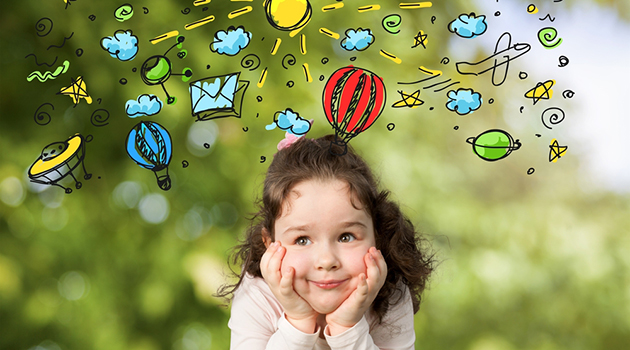
Visualisation – seeing in your mind’s eye – is developed and learned. We are not born with the ability to visualise. Visualisation is a crucial skill for success in learning and retaining information. It does not develop by itself: it is the result of input from all the sensory systems, especially the tactile and auditory systems. It is quite possible for a child to have perfect eyesight but still have difficulty with visualisation, which is a necessary skill for reading, writing and spelling.
For example, our work involved creating spelling words out of soft clay. The child would place the letters in order, touch and look at the letters, close their eyes and answer questions about it, e.g. “In the word ‘excellent,’ what is the first letter? How many e’s are there in it?” By creating a clear picture in their head, the child was quickly able to spell the word backwards and forwards. We would encourage a child or adult to ‘take a photo’ of the word in their mind and to look at it backwards and forwards. The focus was on mental visualisation, rather than relying on repeating the word to themselves (as we are all caught doing with names and telephone numbers).
A great visual memory exercise is the game ‘I went on holiday and took…’ in which each person adds an item to the list: ‘I went on holiday and took a suitcase, an umbrella, a chocolate bar, a hockey stick..’ This requires creating a mental picture (or even a story in one’s head). This game alone develops visualisation skills. I think of it as a stretching exercise for the mind – with practice it becomes easier to remember more and more items. Visualisation is especially useful in class: when the teacher gives instructions, a child will form an image in their head of the tasks given and remember them more easily.
Another visualising exercise is ‘mental decorating.’ If a child has trouble remembering a particular letter in a word or number in a sequence I ask them to take that letter or number and ‘decorate’ it. To remember the letter ‘c’ in the word ‘excitement’ a child might imagine it as giant and bright yellow, tiny and polka-dotted or pink and fluffy. One boy told me his letter was neon green, dripping slime. Not only does this allow children to use their creativity, when they spell the word again it is nearly always clearer in their mind. I have found this to be an extremely effective spelling tool. Promoting visualising skills can improve reading and comprehension, too. Good readers are often able to answer comprehension questions that are asked of them, with detailed responses – however their answers are not consistent. Learning strategies that will help a child build pictures of what they are reading will further develop their reading comprehension. Developing this skill is especially useful when it comes to learning information at high school.
On a teaching placement in Christchurch intermediate schools, our task was teaching at-risk thirteen year olds reading comprehension with non-fiction articles. We encouraged our young charges to read through each paragraph, then think of an appropriate title and image for each paragraph. They wrote the title and drew the accompanying picture in the margin. We then covered the writing and asked them to recall the content of each paragraph. Their recall was at times incredible, which convinced me of the power of visualisation before I even studied it. It was a powerful experience, particularly because I realised that if children and teens are taught how to utilise their visualisation and memory skills their confidence goes through the roof. I was partnered with the tallest, toughest-looking boy of the bunch – Johnny. He towered over me, but what really intimidated me was his apparent disinterest in reading, and schoolwork in general. To my relief, he was polite, but indifferent to me and to the reading activities. This changed pretty quickly (as I find it does, 99% of the time) when he realised that I was teaching him just how amazing his visualisation and memory skills really were. I won’t forget the first time Johnny remembered all the main points of a complicated science article as he couldn’t contain a grin and his eyes shone with the realisation that he had mastered the skill. This boy had confessed to me that he never read outside of school; the next week he shyly pulled out a chapter book his parents had given him. Brilliant stuff!
Visual Recommendations
- Behavioural Optometry
Many people may pass a routine vision check but may still be at risk of poor vision, may squint or have a learning related visual problem that can have a significant effect in the classroom or workplace. The eyes are extremely complex organs and good vision is not limited to the focusing of a clear picture on the retina.
Behavioural Optometry is based on an understanding of the developmental sequence of learning and growth within the human visual system. It recognises the visual system’s interaction with, and dependence upon, the other sensory-motor systems of the body.
Irlen Lenses have the potential to make a huge difference in the areas of eye comfort, stress reduction and general increase in efficiency and energy.
Practitioners of these two modalities do not usually collaborate in their work with a client. Each offers excellent results but often the best results come from a combination of both disciplines.
